
Top 10: Uses of AI in the Food & Drink Industry
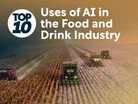
As AI accelerates across industries, the global food and drink sector is undergoing one of its most profound transformations.
From precision agriculture and AI-powered supply chains to robotics, smart ordering systems and personalised nutrition, technology is reshaping how food is grown, produced, distributed and consumed.
Industry leaders are using AI to reduce waste, optimise forecasting, enhance quality control and create hyper-personalised customer experiences.
Food & Drink Digital ranks 10 of the top uses of AI in the food and drink industry, redefining efficiency, sustainability and innovation across the global food and beverage landscape.
10. Reducing food waste
Companies: Choco, Walmart and Ocado
Walmart CEO: John Furner
CEO since: 2026
AI is playing a critical role in reducing global food waste, with nearly 40% of food production lost despite sufficient supply.
Companies like Choco use AI to connect suppliers and restaurants, preventing over-ordering and inefficiencies.
Retailers such as Coop and Carrefour leverage AI forecasting through Google Cloud to optimise inventory, while Walmart and Nestlé apply predictive analytics to improve demand planning.
Ocado’s deep-learning models enhance online grocery forecasting, balancing availability with minimal waste and significantly improving supply chain accuracy.
9. Beverage production
Companies: Heineken, Diageo and The Coca-Cola Company
Heineken CEO: Dolf van den Brink
CEO since: 2020

AI is transforming beverage production and commercial strategy.
HEINEKEN integrates AI across global operations, using tools like AIDDA to guide sales reps with next-best-action insights, Allocation AI to optimise marketing spend and Promo Advisor to enhance promotional planning and profitability.
The Coca-Cola Company applies generative AI in R&D, supply chain and agricultural innovation, including its “Save the Orange” initiative to combat citrus greening.
Meanwhile, Diageo’s FlavorPrint technology personalises whisky experiences, blending AI-driven insights with product innovation and consumer engagement.
8. Ordering systems
Companies: Yum! Brands, NVIDIA and Loman AI
Yum! Brands CEO: Chris Turner
CEO since: 2025
AI is revolutionising ordering systems in restaurants.
Yum! Brands’ Byte by Yum! platform integrates online and mobile ordering, point of sale, kitchen management, delivery optimisation, inventory and labour management across KFC, Taco Bell, Pizza Hut and Habit Burger.
Partnerships with NVIDIA enable AI-driven voice agents, computer vision and analytics to streamline operations, reduce wait times and improve order accuracy.
AI solutions like Loman, eatOS VoiceOS and OrderAI further automate phone and drive-thru orders, enhancing efficiency, customer satisfaction and operational consistency worldwide.
7. Advances quality control
Companies: Nestlé, Siemens and Danone
Danone CEO: Antoine de Saint-Affrique
CEO since: 2025
AI is transforming quality control in food and beverage production.
Nestlé uses AI-powered visual inspections and digital twins to create high-quality, scalable product content and ensure consistency across brands.
Danone’s training initiatives prepare employees to manage AI-driven processes, while Siemens leverages neural networks, predictive maintenance and real-time data analysis via Insights Hub to monitor production, optimise recipes and detect defects.
These technologies increase efficiency, reduce errors and enable precise, consistent and flexible production at scale.
6. Robotics in food service
Companies: ABB, Yum! Brands and Domino’s Pizza
ABB CEO: Morten Wierod
CEO since: 2024

AI-driven robotics are transforming food service operations.
Domino’s partners with Nuro for autonomous delivery vehicles, while Yum! Brands uses Dragontail Systems for kitchen automation and delivery logistics.
In coffee and vending, Second Cup Coffee Company launches Mozo, a robotic barista and Chulchul Box delivers hot meals in 90 seconds.
ABB Robotics provides industrial-grade automation for preparing burgers, mixing drinks and assembling orders with speed, consistency and flexibility.
Robotics can help reduce wait times, improve quality and help businesses manage labour shortages efficiently.
5. Consumer behaviour prediction
Companies: Tesco, Sainsbury’s and Blue Yonder
Blue Yonder CEO: Duncan Angove
CEO Since: 2022

AI and machine learning are transforming consumer behavior prediction in the food and drink industry.
Sainsbury’s uses Blue Yonder to forecast demand, optimise store orders and enhance sustainability, ensuring the right products reach customers efficiently.
Tesco partners with Mistral AI to develop generative AI solutions, improve online order routing and deliver personalised experiences via Tesco Clubcard, enabling more responsive operations and tailored shopping experiences that anticipate customer needs and drive loyalty.
4. Personalised nutrition plans
Companies: Myprotein, Nestlé and VerveSmart
Myprotein Founder: Oliver Cookson
Founder since: 2004
AI is reshaping personalised nutrition, enabling tailored supplement and dietary plans based on individual health, genetics and lifestyle.
VerveSmart, from the same company that founded Myprotein, analyses user inputs on energy, sleep, stress and goals to generate science-backed supplement regimens, simplifying a complex market.
Frost & Sullivan highlights AI-driven nutrition solutions that incorporate biomarker data, microbiome insights and real-time health metrics.
Companies like Nestlé and startups are also leveraging AI to optimise meal plans and functional foods, improving adherence, reducing waste and maximising health outcomes.
3. Optimising supply chain management
Companies: Unilever, Coca-Cola and Nestlé
Unilever CEO: Fernando Fernandez
CEO since: 2025
AI is transforming supply chain management in the food and beverage industry, helping companies optimise production, inventory and delivery.
Unilever uses AI to analyse weather data and predict ice cream demand, enabling more accurate forecasts, adjusting production volumes and improving freezer-stock management across millions of cabinets.
Coca-Cola Bottlers Japan employs o9 Solutions’ Digital Brain platform to integrate demand forecasts with operational data, optimise delivery routes, reduce waste and synchronise production and warehouse resources.
Nestlé and partners are also piloting AI to redistribute surplus food efficiently, cutting waste and CO₂ emissions.
AI-driven insights enhance efficiency, sustainability and service levels across the supply chain.
2. Enhanced food sorting systems
Companies: Nestlé, Tetra Pak and Google Cloud
Nestlé CEO : Philipp Navratil
CEO since: 2025

AI is transforming food sorting and recycling, enabling companies to process waste more efficiently and sustainably.
Tetra Pak, for instance, has invested in AI-powered optical sorting technology to improve the recovery of food and beverage cartons in the UK.
At Levenseat Resource Management in Scotland, Recycleye’s QuantiSort system uses AI and cameras to identify cartons within mixed waste streams, while pneumatic valves separate them for recycling.
This follows earlier upgrades at J&B Recycling and Cumbria Waste Management, marking a significant step in Tetra Pak’s £1.4m 2025 UK investment in sorting infrastructure.
AI is also tackling food waste further up the supply chain.
Nestlé, in collaboration with Google Cloud, Zest, FareShare and logistics partners, is piloting an AI platform to redistribute surplus food.
By matching quality edible products to demand, the system can deliver millions of meals, cut CO₂ emissions and reduce costs, demonstrating the power of AI to enhance efficiency, sustainability and social impact across the food industry.
1. Agricultural farming
Companies: AWS, Syngenta and Bayer Crop Science
AWS CEO: Matt Garman
CEO since: 2024

AI is revolutionising the food and drink industry, transforming how food is grown, processed and delivered.
In agriculture, companies are using AI to improve yields, reduce waste and promote sustainability.
Syngenta employs AI-powered analytics to monitor soil health, predict pest and disease outbreaks and provide farmers with precise recommendations for interventions.
Bayer Crop Science, working with Amazon Web Services and Slalom, leverages generative AI and predictive tools to deliver near real-time insights on weather, soil moisture and crop health, helping farmers make faster, data-driven decisions.
Beyond farming, AI is optimising supply chains and production processes. Predictive analytics enable companies to anticipate demand, manage inventory and reduce food loss.
By combining machine learning, computer vision and sensor data, AI supports precision agriculture, prescriptive interventions and sustainable practices, allowing growers to maximise output while minimising environmental impact.
Through these innovations, AI is reshaping the entire food and drink industry, from field to fork.
Company portals






















Executives

Antoine de Saint-Affrique
CEO

Chris Turner
CEO
Dolf van den Brink
Chairman of the Executive Board/ CEO

Duncan Angove
CEO
Fernando Fernandez
Chief Executive Officer
John Furner
President and Chief Executive Officer, Walmart U.S.
Matt Garman
Chief Executive Officer
Morten Wierod
CEO

Oliver Cookson
CEO
Philipp Navratil
Chief Executive Officer