
Can Electric Trucks Deliver Fresh Produce Without Emissions?
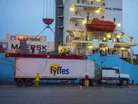
Electric transport is no longer a theory in fresh produce logistics.
A fully electric banana delivery has been completed in the UK, bringing together DP World, Maersk, MAN Truck & Bus and Fyffes.
This collaboration demonstrates that emissions reduction is possible across cold chain logistics, using existing technologies and coordinated action across suppliers, transport providers and logistics specialists.
Bananas present a particular challenge in transport due to their perishability and the requirement for controlled ripening.
But this joint delivery proves electric vehicles (EVs) can handle long-haul, temperature-sensitive loads without compromising product quality or reliability.

Building low-emission supply chains through collaboration
DP World, a global logistics and supply chain specialist, leads the delivery. The company has been scaling up its Low Carbon Truck Programme, integrating electric transport options into everyday operations. The banana shipment travels from DP World’s Southampton terminal to Basingstoke using a fully electric truck — the MAN eTGX, a battery-electric vehicle built for long distances.
Nicholas Mazzei, Vice President of Sustainability at DP World, wrote on LinkedIn: "Yesterday, from our Southampton terminal to Basingstoke, we delivered Fyffes their container of bananas fully electric.
"And, in perhaps what is the most impeccable timing, it all happened while I attended a working session on decarbonisation of supply chains and road transport with the WBCSD – World Business Council for Sustainable Development.
"Just as I was discussing our work with TRATON GROUP CSO Andreas Follér, I got a message from Dave Munday in our UK logistics team that we had successfully delivered the container by using the MAN Truck & Bus SE eTGX."
The eTGX truck, developed by MAN Truck & Bus, is designed for heavy-duty applications, including food logistics.
With charging capacity up to 750kW and the ability to recharge during breaks of around 45 minutes, the vehicle offers a range of up to 350 kilometres, making it viable for regional and inter-city transport routes.
Nicholas adds: "Making the EV transition happen can't be done by any one company. It took MAN, Maersk, Fyffes and DP World to make this happen. But the key is that it did happen and it will happen more and more."
Maintaining cold chain standards with container innovation
While the electric truck ensures emissions are cut on the road, Maersk ensures the bananas are transported under ideal conditions.
With extensive expertise in cold chain logistics, Maersk uses its StarCare and StarRipe containers for banana shipments.
These specialised containers control key parameters like temperature, oxygen and carbon dioxide.
The StarRipe container includes a controlled ripening function.
This allows ripening to occur automatically according to a customer’s preferred level when the container is opened.
This technology enables bananas to ripen on the move, reducing the need for separate ripening facilities at the destination.
"We have been ripening bananas on the move for some time now, so it is no longer a question of whether it works – now it is about sitting together with our customers and finding how this technology best fits into their processes and their supply chain," adds Michaela Steineker, Senior Business Development Manager at Maersk.
This end-to-end process enables Fyffes, the world’s largest importer of Fairtrade-certified bananas, to maintain quality and shelf life while reducing the carbon footprint associated with long-distance, temperature-controlled logistics.
Scaling sustainability with shared infrastructure
Fyffes works with Maersk and DP World to optimise delivery routes and container use.
By combining efficient shipping lanes, electrified road transport and precision container control, the supply chain achieves both sustainability and product integrity.
The shipment shows how ESG targets can translate into operations.
DP World and Maersk have public sustainability goals in place, with a strong focus on decarbonising freight.
MAN Truck & Bus sees electrification as its main contribution to climate action and is rolling out battery-powered commercial vehicles at scale.
The move towards electric transport in produce logistics requires synchronisation across the supply chain.
From vehicle design to shipping schedules and container control systems, each partner plays a role in maintaining efficiency while cutting emissions.
This collaboration between DP World, Maersk, Fyffes and MAN Truck & Bus shows the viability of electrified supply chains, not just for bananas, but for any cold-chain-reliant product.
Electric trucks, when integrated into a well-managed logistics network, provide a low-emission solution without compromising performance or quality.
By proving that an electric vehicle can deliver perishable goods at scale, these companies set a clear example of how decarbonisation can be embedded into everyday logistics decisions.