
Freixenet Turns to FANUC for Automated Production Tech
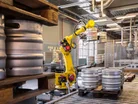
Spanish producer of cava and other sparkling and still wines, Freixenet, has integrated 36 robots into its wine manufacturing process, and the company now has a fully automated process to make the production of 185 million bottles more efficient.
In 1996, Freixenet, a leading Spanish wine producer, had the “crazy idea” to automate the drinks production process. Now, this automation is a reality; industrial robots span each area of manufacturing, from bottling and storing to palletising and baling.
The technology is provided by FANUC, which is the largest manufacturer of computer numerical control (CNC) automation technology, with 65% of the global market. It is also the leading global manufacturer of factory automation systems.
“Where other robot manufacturers saw only difficulties, FANUC saw opportunities and encouraged us with the project”, says Freixenet’s Maintenance Manager, Pere Gibert Guasch.
“In collaborating with the best brands, we strengthen our leading position in innovation and in the quality of our facilities, which contributes to increasing the value of our biggest asset: producing the world’s best cava, with maximum food quality and safety, in the most efficient and sustainable form,” he added.
Manufacturing automation has long been a Freixenet goal
The automation began with two of FANUC’s 410 series robots, named Zipi and Zape by the winery staff.
Now, the company has 36 robots across its manufacturing operations, and employs FANUC’s annual maintenance and in-plant hotline services to ensure they run efficiently.

Freixenet sees its current robotics fleet as proof of the collaborative relationship it has with FANUC.
“FANUC robots,” says Pere, “have always adapted to our particular needs.
“In our customer-supplier relationship, we consider the treatment we receive from the FANUC team to be close, attentive and collaborative in helping us find the best solution to our challenges.
“After a relationship that has lasted 18 years, our collaboration has been and is very valuable. The current fleet and our prospects of expansion are proof of this,” he concludes.