
How Is PepsiCo Improving Soil Health In Its Supply Chain?
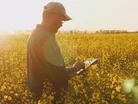
PepsiCo has entered a long-term partnership with agronomic firm Soil Capital to expand the use of regenerative agriculture practices across its European supply chain.
The collaboration is designed to provide farmers in the UK, France and Belgium with access to technical tools and consultancy support aimed at improving soil health and reducing carbon emissions.
This initiative focuses on securing the long-term supply of key raw ingredients such as rapeseed oil, which is used in the production of popular consumer brands including Lay’s and Walkers.
The programme encourages practical changes in farming, such as reducing the use of synthetic inputs, switching to organic fertilisers and adopting cover crops.
These measures are intended to improve soil health, support water efficiency and prevent land degradation.
Archana Jagannathan, Chief Sustainability Officer at PepsiCo Europe, the Middle East and Africa, explains: "Farmers are at the heart of a sustainable food system and regenerative agriculture is key to building resilience for our food supply, the environment and farming communities. Scaling these practices requires practical solutions tailored to local challenges. By working across the value chain, we can help remove barriers, accelerate adoption and achieve meaningful progress reducing agricultural emissions while ensuring the long-term sustainability of our key ingredients."
Financial support and data-led farming
The project between PepsiCo and Soil Capital covers more than 35,000 acres (14,000 hectares) of farmland, providing solutions adapted to local conditions.
For example, in France, the programme helps farmers cope with heavy rainfall, while in the UK, the focus is on overcoming soil compaction issues.
This region-specific approach is aimed at addressing the structural and financial barriers that can limit the transition to regenerative practices.
Farmers who participate in the programme receive financial support to help cover the costs of implementing methods like reduced tillage and cover cropping.
They also receive tailored agronomic guidance from Soil Capital’s advisors. A key component of the initiative is the use of digital tools that allow growers to track carbon emissions across their operations.
This system is supported by monitoring, reporting and verification (MRV) technology, which includes satellite data and modelling tools to provide evidence-based reporting on greenhouse gas (GHG) emissions and soil carbon storage.
Measurable environmental impacts
Initial results from the programme's first phase show notable environmental effects. According to the data from participating farms, the GHG balance has improved by 38% in France and 36% in the UK.
The use of cover crops, which help to boost organic matter in the soil and improve its water retention, has also increased. In France, adoption has risen from 49% to 65% while in the UK it has grown from 22% to 34%.
Additionally, French participants have successfully halved their use of mineral phosphorus fertiliser, a major contributor to environmental degradation.
Reducing this input lessens the dependency on resource-intensive materials and could support more circular nutrient cycles within the farming system.

A framework for scalable agriculture
The collaboration is built on a shared goal of making regenerative agriculture a widespread practice.
Soil Capital CEO Chuck de Liedekerke says: "PepsiCo and Soil Capital have come together around the shared ambition to make regenerative agriculture the norm, not the exception. This is a partnership founded on putting farmers first and working to transform the food system at scale and with pace. Backed by science and measurable environmental benefits, we look forward to supporting the transition, building resilient agricultural supply chains and reimagining the relationship between society, land-use, food and nature."
The outcomes are also reflected in the experiences of the growers involved. David Fuller-Shapcott, a farmer in the UK, says: "Regenerative farming has changed the way I work. With the right support, I’ve introduced cover crops and reduced tillage, cutting my farm’s emissions by 360t between 2022 and 2023 and becoming a net carbon storer. Seeing these changes firsthand proves that sustainable practices don’t just work – they make a real difference for farmers like me."
This partnership is part of PepsiCo's wider commitment to sustainable agriculture, which includes a target to implement regenerative practices across 10 million acres globally by 2030.
By combining financial support with data-led insights and technical guidance, the collaboration provides a potential framework for how multinational companies can work with partners and farmers to secure critical ingredients while transitioning to more sustainable production models.
Company portals


Executives

Archana Jagannathan
Chief Sustainability Officer, Europe, Middle East and Africa

Chuck de Liedekerke