
How is PepsiCo's pep+ Strategy Driving Sustainability?
PepsiCo’s products are consumed over a billion times daily across more than 200 countries and territories, giving PepsiCo a substantial opportunity to influence sustainable practices within its value chain and in households globally.
In recognition of its efforts, PepsiCo has been ranked 16th in the Top 250 Most Sustainable Companies in the World 2025, a placement that highlights its pep+ strategy and the leadership of its Chief Sustainability Officer, Jim Andrew.

The ranking acknowledges PepsiCo's approach to embedding sustainability into its business, from sourcing raw materials to product innovation and ecosystem management.
PepsiCo has made notable advances in areas including regenerative agriculture and water stewardship, positioning the food and beverage business as a contributor to corporate sustainability discussions.
The pep+ strategic framework
Central to PepsiCo’s sustainability work is its PepsiCo Positive (pep+) strategy.
Launched in 2021, pep+ is a strategic framework designed to integrate sustainability throughout PepsiCo's value chain.
The initiative is built on three core pillars:
- Positive Agriculture which is focused on improving sustainable ingredient sourcing and the livelihoods of farmers.
- Positive Value Chain, which aims to create more circular and inclusive supply chain practices.
- Positive Choices, which guides the innovation of food and beverage products intended to be better for people and the planet.
Since its launch, pep+ has led to advancements in regenerative agriculture and water stewardship.
According to PepsiCo Chairman and CEO Ramon Laguarta, pep+ is truly “the future of our company,” directing actions that work towards sustainable growth and long-term value.
Leadership and corporate responsibility
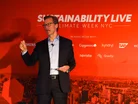
Jim Andrew, PepsiCo’s Executive Vice President and Chief Sustainability Officer, has been instrumental in guiding PepsiCo's sustainability agenda.
Recognised at the top of Sustainability Magazine’s Top 250 Leaders in Sustainability 2025, his leadership directs the pep+ strategy and its integration into PepsiCo's operations.
“I’ve always said sustainability is a team sport, so being ranked No. 1 on Sustainability Magazine’s Top 250 Sustainability Leaders list means that we’ve got a truly fantastic team at PepsiCo – very importantly, including our business general managers – driving our pep+ transformation forward,” Jim explained.
“PepsiCo has shown we’re ready to help lead and be part of the solution, and I’m proud that our team has been recognised with this honour. Congratulations to everyone named (and to many of you, thanks for your partnership!) and to all who are behind the scenes doing the hard work that needs to be done.”
With over three decades of experience, including roles at Boston Consulting Group and Royal Philips, Jim has overseen initiatives that have resulted in a 33% reduction in Scope 1 and 2 emissions since 2015 and a doubling of PepsiCo's regenerative agriculture footprint in 2023.
Regenerative agriculture and water stewardship
Regenerative agriculture is a core component of PepsiCo's strategy to enhance agricultural resilience and lessen its environmental footprint. PepsiCo, which sources over 35 crops and ingredients globally, has set a target to implement regenerative practices across seven million acres by 2030.
In 2024, PepsiCo reported it had expanded its regenerative agriculture footprint to over 3.5 million acres. Partnerships, such as one with Cargill in Iowa, provide farmers with technical support and financial incentives to adopt practices like crop rotation and cover cropping.
In water stewardship, PepsiCo is working towards achieving net water positivity by 2030.
PepsiCo met its 2025 target for a 25% improvement in operational water-use efficiency in high water-risk areas two years ahead of schedule.
This was achieved through innovations like recycling water from potato chip production and using membrane bioreactor technology to purify and reuse process water, which has reduced freshwater consumption at manufacturing sites.
PepsiCo also engages in partnerships with conservation organisations, including supporting projects to preserve aquifers in South Africa.
Reflecting on the company’s progress, Jim says, “I’m proud that PepsiCo was ranked No. 16 in Sustainability Magazine’s list of Top 250 most sustainable companies! This is a reflection of how far we have come and the relentless efforts of our teams to embody and embed pep+, continuing to progress on our ambitious sustainability targets in an effort to strengthen our business and have a positive impact on the planet.”