
The food industry is undergoing a profound transformation, driven by changing consumer preferences, environmental concerns and endless technology advancements. At the forefront of this evolution is Kraft Heinz, one of the world’s largest food and beverage manufacturers, which has embarked on a journey to shape the future of food.
As part of this journey, Kraft Heinz is focussing on some of the key challenges facing the food industry, including the demand for ‘better-for-you’ product solutions, sustainable and innovative packaging and digitalisation.
For insight into Kraft Heinz’s transformative journey, we spoke with three key subject matter experts who are helping to steer the company’s direction of travel in all of these areas:
- Andrea Budelli, Chief R&D Officer for Developed & Emerging Markets
- Mischa Stevens, R&D Process, Productivity & Innovation Director
- Mirjam Spreeuwenberg, R&D Technology & Partnership Lead.
Putting the consumer first is at the heart of Kraft Heinz’s DNA, acting as the driving force behind every decision, every innovation and every action the company takes.
We need to design our food to be delicious without, or with much less, salt and sugar,2 says Andrea, who has been with Kraft Heinz for 33 years.
In his current position, he oversees R&D for emerging and developed markets, as well as leading several global transformational pillars aimed at accelerating technological advancements. The primary challenge, he says, is future-proofing R&D, so it can meet evolving consumer preferences.
He and his team achieve this by “focusing on enhancing consumer experience capabilities and driving digital transformation within R&D processes”. He adds: “We are consumer-centric, science-based and forward-looking, and we have to select our technology based on that.”
What some people don’t realise is that sugar and salt play important roles that go beyond taste in products. For example, in addition to adding sweetness, sugar can caramelise to create browning, provide texture and thicken products. So, it’s not as simple as just removing it or replacing sugar and salt with substitutes, because the company can lose those other attributes.
Keeping pace with changing consumer preferences
Making high quality, delicious food is one point of focus, keeping pace with changing tastes in different markets globally is another.
Andrea notes: “In North America, for example, Mexican food will become disproportionately more popular because of changing demographics there, so Kraft Heinz’s portfolio has to be ready to reflect this by catering to a different kind of consumer – one that is looking more for Mexican food.”
This adaptive approach extends to other markets too, including China, says Andrea.
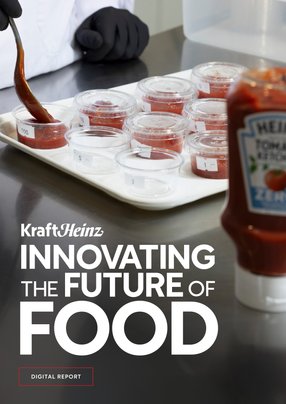
Changing consumer needs drives innovation at Kraft Heinz, which is reflected in the north stars of its technology platforms, says Mischa: “We have consumers on tasting panels and chefs working in the kitchen. We have technologists working in an innovation factory where we can bring products to life for testing and learning at price point.”
Mischa has been at the company for 15 years. His role involves leading the process, productivity and innovation team, which includes finding the relevant partners in the ecosystem, process development and overseeing the innovation factory.
His team is responsible for partnerships, driving technological advancements and identifying cost-saving initiatives. One of the main challenges is balancing the need for lean operations with the imperative to innovate.
Mischa addresses this by maintaining a clear focus on business needs and consumer trends by “using a structured Open Innovation Model to guide decision-making on technology development”.
He explains: “For us, it’s extremely important to understand the market needs, the business partners' needs and the technology unlocks that we are after. That’s our Open Innovation Model and within this we enable and grow technologies. For technology development we normally start with something that has been proven in the lab. Then we’ll proof this into a pilot plant and innovate at factory scale, which leads to consumer facing prototypes.”
Sustainable packaging
“We are seeking to develop sustainable packaging solutions that reduce environmental impact while still meeting consumer needs,” says Mischa. “This means making packaging more lightweight to address carbon content, but also means looking at modern, recyclable (mono)materials.”
This focus on sustainable packaging extends to new food delivery systems, too. Andrea reveals that at the core of Kraft Heinz’s innovation strategy is a focus on enhancing not just the taste and nutritional profile of products, but also how consumers interact with, and use, these products.
“You will start to see more in-store dispensers, more refillable packaging and more solutions that ensures we’re delivering food that tastes good, is good for your health and better for the planet,” he explains.
Kraft Heinz’s strategic needs
The key phrase in Andrea’s answers is “the power of technology and innovation to drive positive change”.
Kraft Heinz is passionate about creating a more sustainable future by tapping into the power of technology and innovation to drive positive change and deliver on its commitments to consumers and the environment.
“We are able to balance short-term business needs with long-term strategic goals because we have created dedicated teams focused on long-term innovation,” Mirjam says.
This approach, she adds, “allows us to maintain our focus on current business needs while still investing in transformative technologies that will shape our future.
In her role, Mirjam draws from 25 years’ experience in R&D within the agrifood business. Her expertise lies in identifying and enabling technologies through partnerships that are relevant to Kraft Heinz’s portfolio.
Finding the right partners at the right time to drive innovation is, she says, a vital part of the role – a role that requires her to provide a bridge between external innovations and internal product development efforts.
She achieves this by “maintaining a wide network of contacts across academia, industry and the startup ecosystem, and by carefully prioritising technology needs, based on business requirements and consumer insights”.
AI driving innovation at Kraft Heinz
Both internally and externally, AI and machine learning are changing commercial landscapes. At Kraft Heinz, they play an ever-greater role in its innovation strategy, where they are used to analyse consumer trends, optimise product formulations and improve manufacturing processes
Technology also plays a pivotal role in helping Kraft Heinz innovate new products to meet people’s shifting tastes and preferences, as well as helping it improve processes and bolster its sustainability credentials.
Mirjam flags the importance of digital tools in all of this: “We embrace predictive modelling and advanced data analytics, using all the data we have available. In this way we can drive efficiency and productivity and it can also help us identify different opportunities.”
“This is why we have adopted an Open Innovation Model,” she adds. “We collaborate with universities, startups and suppliers to drive technological advances. We drive open innovation on technology as we can apply it to the business. We look outside for relevant partners, and have dedicated partnerships and consortia with customers, with research institutes and universities, but also with some startups.”
Collaborative partnerships sharpen competitive edge
“We have made [partnerships] a key part of our innovation strategy,” says Mirjam, emphasising the importance of speed. “These days, because things are going so fast, speed is often critical to success.”
This need for speed is also reflected in the company’s approach to prototyping and product development, says Mischa: “We have a pilot plant, which we call Innovation Factory, where we can produce products and bring them to the consumer. We can produce the next ketchup, bring it to customers and understand, literally in the supermarket, the consumer’s needs.”
Continuing on the theme of product development, Andrea stresses the potential of AI. “If a big company fails to leverage AI and other digital tools in the right way then R&D will not be very efficient. The algorithms we use are so complex that the work they do would take humans years to accomplish.
“For example, to design a product today you need to look at sustainability, nutrition, consumer, differentiation and evolving regulatory frameworks that tell you what you can and cannot do.
“The equation is very complex and AI and machine learning gives us the possibility of managing this equation successfully.”
But just as no company innovates in a vacuum, neither can it meet some of its goals without some measure of industry collaboration. Mischa says that some of the challenges facing the food industry are too big for any company to solve alone: “When an issue is non-competitive, we work in a consortia, where we can work together with our competitors.”
The challenge of managing pan-industry change
This collegiate approach to pan-industry challenges is echoed within Kraft Heinz, particularly in the way it drives forward its big change programmes. As the company looks to the future, it envisions a food industry that is more personalised, sustainable and technologically advanced.
It is this future that continues to drive Kraft Heinz’s never-ending journey of innovation, a programme that is designed to excite, says Mischa: “This is the key point with innovation. Ultimately, it’s about exciting consumers. It is our dream to be a leader in elevating and creating food that makes you feel good.”
Company portals
Executives
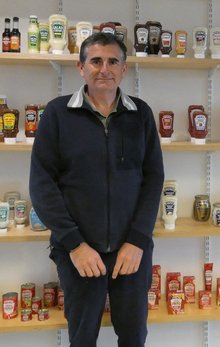
Andrea Budelli
Chief R&D Officer for Developed and Emerging Markets at Kraft Heinz

Mirjam Spreeuwenberg

Mischa Stevens
R&D Process, Productivity & Innovation Director for Developed & Emerging Markets at Kraft Heinz