
How Will Tesco's New Distribution Hub Boost UK Growth?
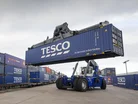
Tesco makes a major commitment with plans for a state-of-the-art distribution centre at DP World London Gateway, scheduled for completion in 2029.
This investment is a key part of Tesco’s strategy to enhance its logistics capability to serve a growing number of stores across the UK.
The multi-million pound venture is designed to meet future demand and solidify the dependability of its supply chain. Tesco says the new distribution centre will be a “modern, energy-efficient site” that uses “the latest technology to support Tesco’s growth.”
Commitment to sustainability
The new facility aims to achieve a “BREEAM Outstanding” certification, a benchmark for buildings with minimal environmental footprints.
BREEAM, standing for Building Research Establishment Environmental Assessment Method, serves as a UK-wide rating system to evaluate a building's sustainability. The “Outstanding” rating is the pinnacle, awarded only to the top 1% of assessed structures.
Tesco partners with logistics specialists Witron, renowned for creating retail-centric supply chain systems, to realise this extensive project.
The centre is set to process dry grocery items, aligning with Tesco’s plans to grow while meeting enhanced sustainability standards.

Andrew Woolfenden, Tesco UK Distribution & Fulfilment Director, says the new centre will play a critical role in future growth: “Our distribution network is vital for ensuring customers receive products at the right place, time and condition.
"As demand grows across our store network, we're excited to partner with Witron and DP World to develop a distribution centre that leverages the latest technology, enhancing our supply chain and supporting our decarbonisation goals.
"By locating at London Gateway, we can also take full advantage of the seaport and rail infrastructure."
Helmut Prieschenk, CEO at Witron, calls it “an honour and pleasure” to be involved, saying: “With the latest technology and machinery, once fully operational, this represents a large-scale project for dry grocery distribution.
"In terms of end-to-end integration this is a lighthouse project for Witron – which ensures premium store service, an ergonomic, safe and sustainable environment and benefits the whole value chain.”
Expansion of London Gateway’s influence
London Gateway stands as the UK’s largest and most connected logistics hub, handling over two million containers yearly and operating beyond 60 weekly rail services.
It offers 9.25 million square feet of logistics park space. This site manages over half of the UK’s deep-sea temperature-controlled imports and hosts a variety of logistics and manufacturing enterprises, including DHL, CEVA Logistics, Currys, COSCO, UPS and SH Pratt Group.
Sultan Ahmed bin Sulayem, Chairman and CEO of DP World Group, says the investment marks an important step forward for the site. “DP World London Gateway is helping to make Britain’s trade flow by sea, road and rail, connecting businesses across the UK with global markets and boosting the resilience of national supply chains.
"The significant investment announced today by Tesco, one of the world’s leading retailers, is a proud moment for DP World and a vote of confidence in the growing role London Gateway plays in the UK economy.”
Although the announcement indicates long-term progress, the port currently faces short-term challenges.
Operational challenges at the port
Amidst Tesco’s plans, London Gateway contends with operational complications.
A sequence of equipment failures and other issues throughout late June has resulted in significant delays.
On 26 June, only half of the port’s cranes functioned. By 30 June, a rail shunting incident impaired infrastructure, pausing rail services until 1 July. This led to over 500 containers missing their scheduled departures, and the backlog continues to disrupt operations.
Hauliers report prolonged wait times and delays in container collection.
Measures like Operation Stack keep vehicles outside the port for over an hour before entry. The current wait time on the quay reaches five hours in some instances. Missed subsequent jobs, decreased fleet efficiency and climbing operational costs bring pressure on haulage companies.
Such delays could result in wasted journey charges if containers cannot be delivered and need rescheduling.
Concurrently, some hauliers introduce London Gateway surcharges, imposing charges for time spent waiting beyond agreed limits.
Despite these disruptions, Tesco’s investment signifies a long-term initiative to bolster its supply chain, aiming at lower emissions and improved reliability.