
How Label-less Packaging Could Shape Beverage Supply Chains
The food and drink industry is currently navigating a major operational transformation caused by a growing momentum towards label-less products.
This change is reshaping how supply chains in the sector functions, from the sourcing of materials to the final delivery to the consumer.
Prompted by new regulatory requirements and increasing sustainability mandates, food and drink businesses are being compelled to rethink their established packaging infrastructure and logistics frameworks to adapt to this new landscape.

The move from traditional physical labels to digital identities represents a fundamental change in packaging operations for food and drink companies.
Kiarne Treacy, CEO of Sustainable Choice Group, said on LinkedIn: "The industry is marking the beginning of the end of physical product labels. Why? Because they are static, impersonal and wildly finite.
"We are moving to a new era of product labelling, compliance will be the instigator but our burning desire for instant gratification will be the catalyst."
For supply chain operators in the food and drink sector, this addresses longstanding inefficiencies.
Traditional labels often require separate production runs for different international markets, creating considerable inventory complexities and waste, particularly for products with limited shelf lives.
Digital solutions allow for centralised production with localised information delivered digitally, which could streamline warehousing and reduce the proliferation of stock-keeping units.
Regulatory frameworks and digital passports
Regulatory frameworks are a primary cause of this change.
The European Union's Packaging and Packaging Waste Regulation (PPWR) is actively reshaping packaging specifications across the supply chain.
The regulation addresses the 180kg of packaging waste generated per person in the EU annually and now requires that all packaging be designed for efficient collection, sorting and processing into new materials.
As part of this, PFAS chemicals, often used in food packaging, are now banned across the EU.
This forces material suppliers to reformulate their products and requires manufacturers to verify compliance throughout their procurement processes.
A key element of this is the Digital Product Passport (DPP), which has evolved into an essential piece of supply chain infrastructure.
This digital record contains unique identifiers, compliance documents and end-of-life instructions, accompanying a product through its entire value chain.
For procurement and logistics teams in the food and drink industry, the DPP offers real-time verification of product authenticity, material composition and environmental impact, enabling more informed inventory and supplier decisions.
Upgrading infrastructure with advanced barcodes
A critical infrastructure upgrade for packaging and distribution networks is the change from linear barcodes to 2D barcodes.
These next-generation codes, such as QR codes powered by GS1, can hold substantially more data than their predecessors.
This can include detailed origin information, comprehensive allergen details and carbon footprint metrics.
Anne Godfrey, Chief Executive Officer of GS1 UK, says: "The next generation of barcodes – QR codes powered by GS1 – will underpin the next retail revolution to give greater power to the consumer."
Smart QR codes enable real-time data updates, allowing brands to manage product recalls with greater precision or provide consumers with market-specific recycling instructions without altering the physical packaging.
Retailers like Morrisons are already implementing this technology to build datasets that track emissions at every point in the distribution network, from supplier facilities to their retail locations.
Material innovation in food and drink
Examples from major brands illustrate the production changes required to adopt label-less packaging.
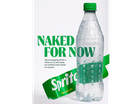
Coca-Cola's expansion of laser-engraved and embossed designs on its Sprite and Sprite Zero bottles is a notable case.
By removing physical labels in 2024, Coca-Cola simplified the recycling process, as it removed the need to separate different materials during processing.
Dusan Stojankic, Vice President of Franchise Operations at Coca‑Cola GB&I, says: "Going label-less might seem like a small step, but it is one of several ways we are exploring making recycling easier, minimising waste, and minimising the impact of our packaging on the environment."
Similarly, Evian has transitioned towards 100% recycled PET bottles featuring embossed logos, removing traditional adhesives and plastic sleeves from its packaging.
These approaches reduce material complexity and improve sorting efficiency at recycling facilities.
The move towards label-less packaging requires major adjustments to production and sourcing, demanding investment in new equipment and the development of supplier networks for sustainable, food-grade materials like rPET that are compatible with direct printing or laser etching.
Company portals


Executives
Anne Godfrey
CEO

Dusan Stojankic
VP Franchise Operations

Kiarne Treacy
CEO