
How High-Protein Products are Fuelling Danone's Growth
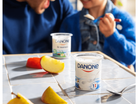
Danone's latest annual financial performance could suggest a broader transformation taking place across the dairy sector.
The company's high-protein range, which includes Oikos, GetPRO and HiPRO, continued to deliver double-digit growth throughout 2025, even as the wider yogurt portfolio was characterised as a "work in progress."
According to Chief Executive Officer Antoine de Saint-Affrique, growth in North America was largely driven by the "winning momentum" of high-protein products, which helped compensate for weaker performance in other dairy categories.
These top-line numbers, however, mask a more complex supply chain narrative.
The GLP-1 opportunity
The unforeseen influence of GLP-1 medications on purchasing behaviour could be transforming the dairy market in unexpected ways.
Approximately 14% of adults in the US have used GLP-1 drugs for weight loss or to manage conditions including diabetes. These appetite-suppressing treatments have generated considerable concern throughout the food industry, with many anticipating a substantial decline in overall consumption.
Danone appears to have converted this threat into a commercial advantage.
Its protein-rich, low-sugar products have benefited significantly from the trend, and the business has started marketing its offerings directly to users of these medications.
Shane Grant, former Deputy CEO of Danone Americas, said: "75% of (US consumers) want more protein in their diet, and GLP-1s are only accelerating this demand. We see the explosive growth across lots of demographics and occasions."
According to Circana data provided by Danone, retail sales of Oikos increased by 40% during 2024. Too Good & Co and Light & Fit have also experienced growth in sales among GLP-1 users.
Responding to capacity constraints
To maintain this trajectory, Danone has had to shift decisively from a bulk dairy approach to what it terms an Agile Nutrition model.
The most tangible demonstration of this strategic pivot is its £110m (US$138m) investment in its Minster, Ohio facility. This represents a response to a genuine constraint in high-concentration processing.
Manufacturing products containing 20 grams or more of protein per serving requires specialised ultra-filtration technology to eliminate water and lactose whilst concentrating casein and whey proteins.
The new production lines are specifically designed for these high-viscosity products. Danone North America sources 90% of its ingredients and packaging within the US. This represents a "regional for regional" strategy intended to protect the business against the type of global shipping disruption that proved costly in 2024 and 2025.
The expanded facility also features a semi-automated logistics centre, capable of managing the heightened complexity of high-velocity SKUs that move considerably faster through the supply chain than conventional yogurt lines.
All sustainability, net zero and sustainable supply chain leaders should attend:
- Sustainability LIVE: The Net Zero Summit - QEII Centre, London, March 4-5
- Sustainability LIVE: The US Summit - Navy Pier, Chicago, April 21-22
Co-located with Procurement & Supply Chain LIVE, these events brings together CSOs, ESG leaders and senior decision-makers at a moment when sustainability, supply chains and commercial performance are increasingly interconnected.
Tickets can be booked online today for The Net Zero Summit and The US Summit. Group discounts available.
Transforming relationships with farmers
Meeting a projected 60% rise in milk demand has required Danone to fundamentally reconsider its upstream relationships.
Rather than simply procuring additional milk, the business has established its Milk Academy. This is a global programme with a centre of excellence in Ohio to educate farmers in regenerative agriculture.

This is not simply a sustainability initiative. More stable soil could result in more predictable feed costs, which in turn could stabilise Danone's raw material pricing.
As part of its Triple A climate commitments, Danone is also collaborating with farming partners to reduce methane emissions by 30%. This is a consideration that could be growing increasingly important to European and North American retailers alike.
Looking forward, the global supply chain faces what could reasonably be described as a transparency challenge.
Forthcoming 2026 regulations, including the EU Deforestation Regulation and the Green Claims Directive, will require Danone to demonstrate that every litre of milk and every tonne of soy in its supply chain is deforestation-free.
At the same time, 20 grams of protein has become a new consumer baseline globally, intensifying competition for high-quality whey and plant proteins and driving protein-focused mergers and acquisitions across the industry.
Danone's decision to market directly to GLP-1 users is, fundamentally, a demand-shaping strategy. It is one that could optimise factory utilisation around the company's most profitable lines whilst future-proofing the supply chain against an increasingly complex global landscape.
Company portals
Executives

Antoine de Saint-Affrique
CEO

Shane Grant
Deputy CEO of Danone Americas